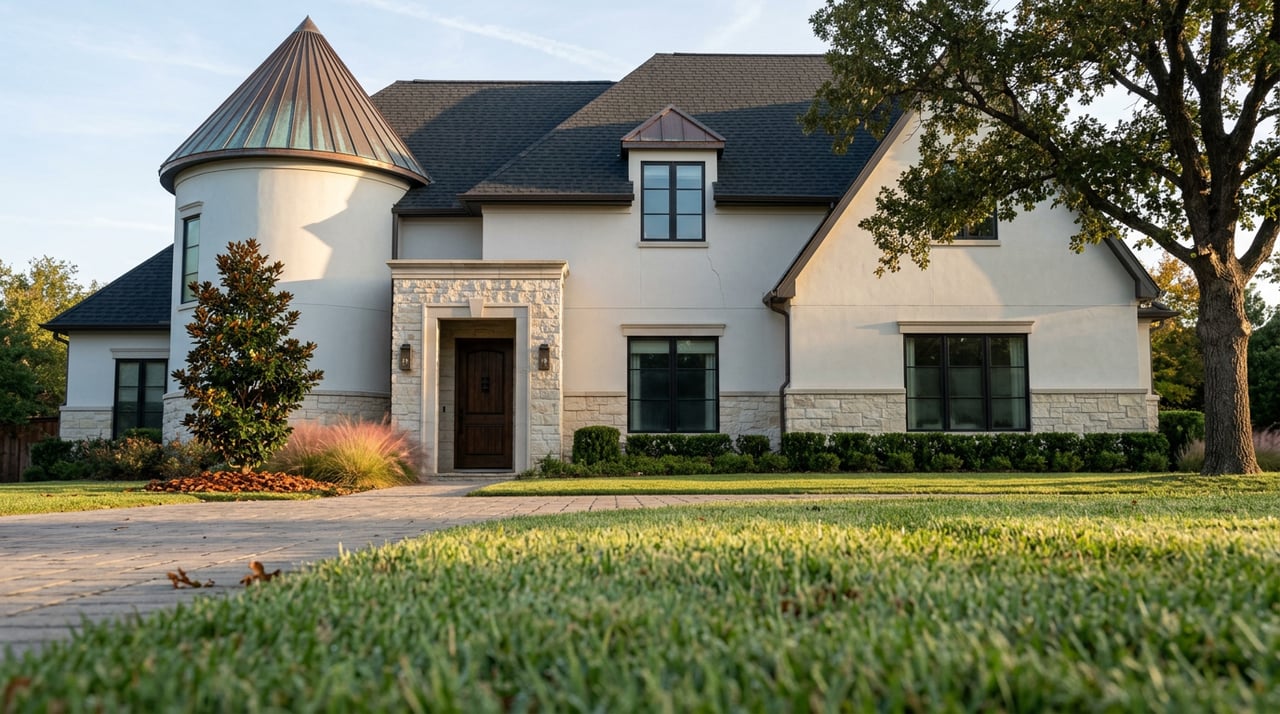
A buyer filters Edmond listings for new construction, sets the price ceiling somewhere north of a million, and Fairview Farm comes up. The photos show the stonework facades and steep gables the neighborhood is known for. The buyer pictures the usual sequence: pick a lot, meet the builder, choose finishes. Then the agent explains that the home on screen is a resale from the neighborhood's original build-out, and the only path to anything genuinely new is a scarce infill parcel, either vacant or one where an older home would need to come down first.
That gap between what the filter promises and what the neighborhood can actually deliver is the thing worth understanding before you tour anything behind those gates.
A neighborhood with a long build-out history
Fairview Farm sits at the northwest corner of NW 150th and Western, and its first homes went up in 1993. That is not a typo carried over from an old listing sheet. Construction there has been running for more than three decades, which means the neighborhood has had time to do something most Edmond subdivisions haven't: fill up. The community holds roughly 125 homes behind four gated entrances, with a large pond running through part of the neighborhood and many homes built to face the water.
A neighborhood with a long build-out history behaves differently than a subdivision still selling phase two. In a past count of the neighborhood's buildable lots, brokers put the remaining total at roughly 75 out of the 125 homesites platted for Fairview Farm and its Abbey section combined. That figure is old enough now that it shouldn't be treated as current inventory, and it does not establish how many homesites remain today.
The builders who shaped it read like a roster of Edmond's established custom-home names from that era. Henry Coffeen, Jim Quigley, and Larry Russell all have homes in the neighborhood, each bringing their own read on the French and English styling that defines the streetscape: stonework, rounded turrets, steep pitched rooflines, dormer windows. That variety is part of the appeal. It is also evidence that most of what you're buying in Fairview Farm was designed and built by someone else, years ago, for someone else's family.
Three different products are wearing one label
The word "new construction" gets applied to three genuinely different transactions inside Fairview Farm, and conflating them is where buyers get tripped up.
| What you might find | What it actually is | What buying it involves |
|---|---|---|
| A home listed as recently built | Almost always a resale from the 1990s through 2010s, by one of the original custom builders | Standard resale purchase, inspection on an established structure |
| A home in The Abbey | A later addition within the gates built for buyers wanting smaller lots and lower maintenance | Newer construction, but not a ground-up custom commission |
| A vacant or teardown lot | The rare case where true new construction is possible | A builder contract signed before you own the dirt, plus a construction loan and a build timeline |
The Abbey is worth understanding on its own terms. It was added within Fairview Farm specifically for buyers who want the address and the gates without the acreage or the upkeep of the original estate lots. Homes there are newer than the neighborhood's median vintage, but they were built as a cohesive section rather than commissioned one at a time, which changes the design conversation compared to a from-scratch custom build.
The third category, the actual infill or teardown lot, is the only place "new construction" means what a buyer typically expects it to mean: a relationship with a builder, a set of plans, a construction draw schedule. It is also the scarcest of the three, and it rarely shows up labeled clearly as such on a portal search.
Why the median price you see online has nothing to do with what's behind the gate
Pull up a comp tool for an address on Fairview Farm Boulevard and, as of July 2026, you'll find a median sale price sitting around $342,000. That number is real, but it isn't describing Fairview Farm. It's describing a comp radius that pulls in the broader non-gated pocket of the ZIP code surrounding the neighborhood, blending starter homes on Sugar Loaf Drive and Camden Way into a dataset that has little to do with what closes inside the gates.
Inside the gates, the pricing band looks different. A 2024 survey of the neighborhood put average sale prices around $1.15 million, with a spread from the $600,000s to more than $2 million. That is not a contradiction of the lower ZIP-wide figure. It's a reminder that automated comp tools default to geography, not to gates, HOA boundaries, or architectural covenants, and a median built on the wrong boundary tells you almost nothing about the property you're actually considering.
A gated community's median price is only as trustworthy as the comp radius drawing it.
If you're comparing Fairview Farm to another Edmond community using a portal's headline number, you're very likely comparing the wrong two numbers.
The financing and timeline shift once "new" means infill
If the transaction you actually want is ground-up new construction, the mechanics change the moment you're working with a scarce infill lot instead of a builder's open inventory in a growing subdivision.
A builder selling from an active phase in a newer community can offer you a plan, a price, and a start date because they control the pipeline. A builder taking on an infill lot in an established neighborhood like Fairview Farm is working within an existing HOA's architectural guidelines, coordinating utility tie-ins to a decades-old grid, and often pricing the project around whatever the previous structure's demolition and site prep required. That tends to compress your negotiating room on price and stretch your timeline on permitting, particularly when the design has to clear an architectural review board built to preserve a specific streetscape.
It also means the builder relationship matters more here than it would in a fresh subdivision. Builders who already have standing with an established neighborhood's HOA, and a track record other owners in that neighborhood can vouch for, move through review faster than a builder walking in cold. That is precisely the kind of local relationship LISTORSHOW has built with luxury builders across Edmond and Oklahoma City, and it is worth asking any agent showing you a Fairview Farm lot whether they can make that introduction before you commit to a contract.
What this means if you're comparing Fairview Farm to somewhere still developing
None of this makes Fairview Farm a worse choice. It makes it a different one. If what you want is an established, architecturally consistent, gated neighborhood with mature landscaping and a fixed character that a newer development hasn't earned yet, that established character is the point, not the drawback. The tradeoff is simply that "new construction" here means something narrower and more deliberate than it does in a community still selling phase three.
If you're touring the neighborhood and want to understand which of the three products you're actually looking at, that's worth a direct conversation before you fall for the photos. You can start by looking at what's currently available on the Fairview Farm neighborhood page, where listings are shown alongside the context that a bare MLS search usually strips away.
Fairview Farm rewards buyers who know which version of "new" they're actually purchasing. Get that part right, and the rest of the transaction gets considerably more straightforward.
Ready to see what's actually available behind the gates? Get a Free Home Valuation and let's talk through which of Fairview Farm's three product types fits what you're looking for.
This article is general information, not legal, tax or financial advice. Consult a qualified professional about your situation.