If you've walked past the tennis courts off the loop road in the past few months, you've probably noticed the new lines. Bright, layered over the old ones, forming a grid where there used to be one big rectangle. No fence extension. No new asphalt pad next to it. No ribbon-cutting. Just paint, laid down over a surface that was already there.
That's the whole story, and it's worth sitting with for a second, because it tells you something about how this neighborhood actually operates that a walk around the lake won't.
The Court Got Repainted, Not Rebuilt
Mulholland's HOA describes what happened in plain terms: the courts were resurfaced and given dedicated pickleball striping, open to all residents in good standing. No mention of a second phase, a separate pickleball-only structure, or a capital assessment tied to new construction. The existing tennis courts got a second identity painted onto the first one.
That's worth contrasting with how a lot of newer developments handle the same demand. When a builder is putting up a neighborhood from scratch, pickleball courts get their own line item: a dedicated pad, sometimes multiple courts, built as their own amenity from day one. In Mulholland, the infrastructure already existed. The trend showed up, and the neighborhood absorbed it into what was already sitting there.
That retrofit sits within a larger pattern of existing neighborhood amenities.
The Lake Already Had the Job
Here's the part that actually explains why the retrofit worked without friction. Mulholland already had a gathering point before pickleball ever entered the conversation. The neighborhood's own description calls the stocked lake, its aerating fountain, the gazebo, and the pedestrian bridge "the social heart of the community." That phrase isn't decoration. It's a statement about where people already went before there was a reason to add anything new.
A new amenity usually has to create its own gravity. It needs to become the place people go, the thing they schedule around, the reason they leave the house on a Tuesday evening. Mulholland's pickleball courts didn't have to do that work, because the gravity already existed a short walk away at the water. The courts slotted into a pattern of evening foot traffic that the lake, the bridge, and the gazebo had been running for years. Nobody had to build a reason to be outside. The reason was already there.
That's the difference between adding an amenity to a blank lot and adding one to a neighborhood that already has a rhythm. The second kind doesn't need marketing. It needs a bucket of paint and a stencil.
Inside the gate, the pieces that make up an evening are all close enough to hit in one loop:
- The lake itself, stocked and centered around the aerating fountain
- The gazebo at the water's edge, the default stop for anyone walking the loop after dinner
- The pedestrian bridge connecting the lake side to the rest of the common area
- The resurfaced courts, now split for pickleball as well as tennis
- The stretch of mature common-area landscaping that runs along the walking route between all of it
None of these are new. That's the point. The newest thing on the list is paint.
A Recognition Program That Predates Any of This
The HOA runs a long-running tradition recognizing the residents whose yards help keep Mulholland one of the prettiest neighborhoods in Edmond. It's not tied to a season or a single event. It's ongoing, folded into how the neighborhood already talks about itself, and it existed long before anyone painted new lines onto a tennis court.
That continuity matters more than it looks like it should. A neighborhood that has run the same recognition program for years, without needing to rebrand it or attach it to a bigger event, is a neighborhood where change tends to get absorbed quietly rather than announced. The pickleball striping fits that same pattern. It didn't get a launch. It got added to the list of things the neighborhood already does well, the same way a new front bed gets added to a yard that's already been recognized twice.
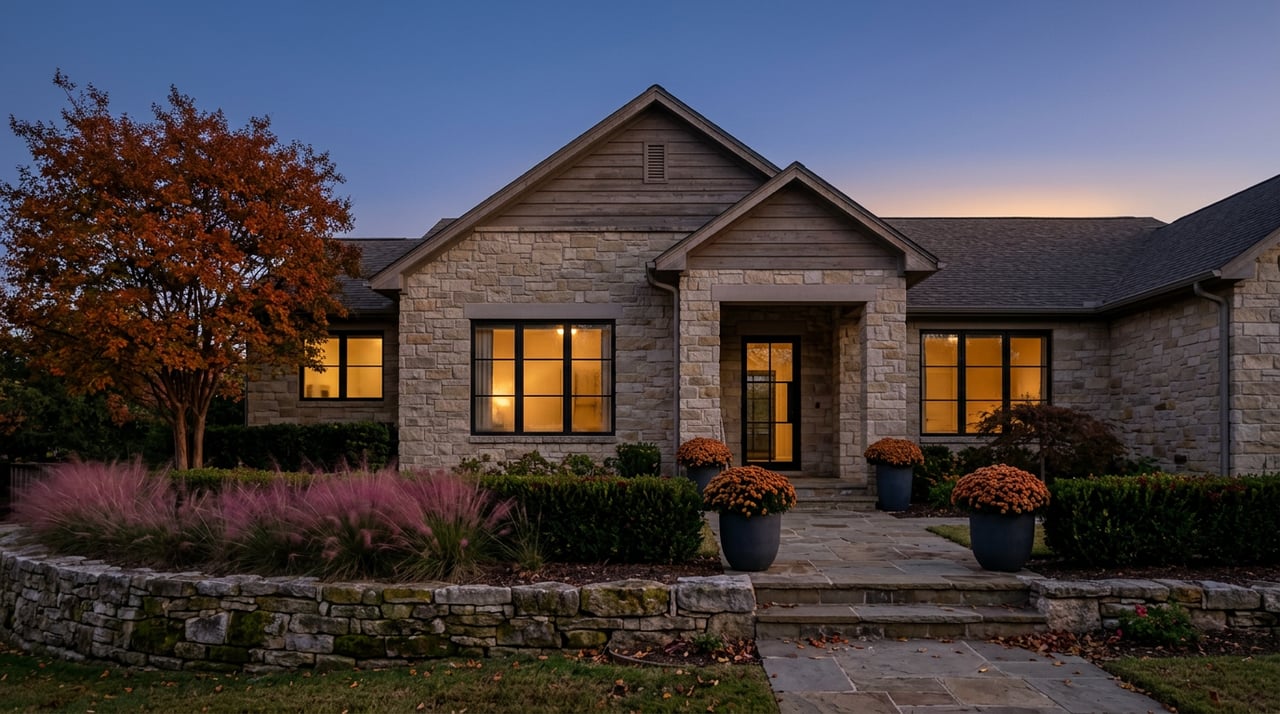
If you've lived here more than a season, you've probably noticed this about Mulholland generally. Nothing gets torn out to make room for the next trend. Things get layered on top of what already works, the same way this fall's mums get planted into beds built around shrubs that were already established.
The Loop That Runs Without Leaving the Gate
The corridor just outside the gate has its own rhythm, one that shifts every time a new restaurant opens or a menu changes. Inside the gate, the rhythm moves at a different speed. It doesn't open on a Friday night. It gets resurfaced in a weekend and shows up on a Tuesday evening when someone walks past and notices the new stripes.
A fall evening here doesn't require a car. It's a walk to the gazebo while the fountain runs, a look at whichever yard has the fall color in early enough to catch attention for next year's recognition, and a game or two on the newly striped side of the court before the light goes. None of it is new construction. All of it was already built. The only thing that changed was the paint.
That's not a small distinction if you're the kind of resident who pays attention to how a neighborhood spends money and attention over time. Some places add amenities by building more square footage. Mulholland adds them by finding a second use for the square footage it already has. Worth knowing, whether you've lived here for ten years or you're the one explaining the neighborhood to someone else for the first time.
If you're weighing what a home inside a neighborhood with this kind of established rhythm is actually worth right now, or thinking about what comes next for a property here, LISTORSHOW can walk you through it. Reach out for a free home valuation and a straight read on where things stand.
This article is general information, not legal, tax or financial advice. Consult a qualified professional about your situation.